More Than Old Buildings: Why Their Preservation Matters


Published on February 18, 2026 by The Roanoke Rambler, we thought you might find this article interesting regarding the recent destructions and removal of Roanoke’s historic fabric and why its important for all of us not to do so. 

Click on the link below for  story………………

https://www.roanokerambler.com/history-takes-a-hit-wrecking-ball-swings-as-advocates-try-to-stave-off-more-demolition/


History Takes a Hit: Wrecking Ball Swings as Advocates Try to Stave Off More Demolition

“Preservation shouldn’t depend on who shows up at the last minute,” said a local advocate.

Published by the Roanoke Rambler.  Visit www.roanokerambler.com to see the original posting or to support them by subscribing to their online news service.   

From left: The Roanoke College-owned house in Salem, Justin Miller stands outside the now demolished home at North Cross, and the Washington Park cottage. SALEM AND WASHINGTON PARK IMAGES BY ROANOKE RAMBLER EDITOR TODD JACKSON, NORTH CROSS IMAGE COURTESY OF JUSTIN MILLER

Historical preservationists are scrambling as numerous properties in the Roanoke Valley face demolition or have already been razed.

North Cross School tore down a farmhouse in January on its property that dated to the early 1800s.

A pre-Civil War house on North Market Street in Salem — owned by Roanoke College — is slated for demolition with bulldozers on site. A late appeal has bought the home at least another few weeks.

And likely to be decided soon is the fate of the much-debated 200-year-old Washington Park caretaker’s cottage tied to Black history and owned by the city of Roanoke, with demolition still a distinct possibility. The caretaker’s cottage decision will come as the longer-term sustainability of another historic Roanoke-owned property, the Fishburn Mansion, also took a recent blow.

What’s up with the current trend? Some of it is simply due to a lack of money during leaner times.

Roanoke College, for instance, says the costs of restoration and upkeep of the Market Street house are too substantial. Roanoke officials, citing revenue needs, have already said the city will have a hard time coming up with taxpayer money to save the Washington Park cottage. Meanwhile, the city is cutting $1.5 million for the Fishburn property from its upcoming projects list. And that amount represents only a fraction of total restoration work needed, based on the home’s needed maintenance and repairs recently presented to council.

Alison Blanton is a long-time public face of historic preservation in the valley. She is a trustee of the Roanoke Valley Preservation Foundation and an architectural historian.

Asked about the situation, she wrote in an email: “I may need to write a letter to the editor or something to bring this growing trend to the public’s attention! We need to do a better job of making people aware of the significance of these properties!”

In a separate interview, Blanton said elected officials, in her experience, are more into “swing sets and soccer fields” than they are historic preservation.

Schools, colleges, churches and other institutions almost always do what is expedient for them without much concern for what they are destroying, wrote Mike Pulice, a Roanoke Valley-based architectural historian with the state Department of Historic Resources.

Neither state or federal governments have any control over what a property owner does to its own property – even if it’s on the National Register of Historic Places, and the house on the North Cross campus didn’t even have that designation, he continued.

Blanton said she’s also worried that Roanoke zoning changes enacted in 2024 – which open properties up to expanded housing choices – could put other historical structures in jeopardy. That’s because developers could make more money by tearing down what’s on a particular parcel and building as many units as possible.

An example is Huntingdon, a Federal period gentry farmhouse built in 1819 that’s located off Roanoke’s Williamson Road. It was once the center of a 500-acre plantation. The home, owned by a private limited liability company, has fallen into some disrepair as it sits empty. It’s been on the state and national historic registries for 34 years.

Preservationists such as Blanton said saving Huntingdon must be a priority.

The Roanoke zoning changes “raised the stakes so much higher,” she said.

The North Cross house

Officials at North Cross, the private school in Roanoke County, did not respond to multiple messages left with them by The Roanoke Rambler in recent weeks to inquire about the decision to raze the structure on its campus – or if any of it was saved.

Blanton said the preservation foundation did document the house last summer after learning of its possible demolition. 

Roanoke County spokeswoman Amy Whittaker confirmed North Cross obtained a demolition permit. The county has no submitted plans from North Cross concerning any further development of the site, she wrote in an email.

Justin Miller, a preservation advocate who works in construction, made an attempt to save the house, which was in disrepair. 

Miller, who grew up nearby, said he watched the house deteriorate at a more rapid rate over the past few years. He said he learned the property’s history from the Maycock family that had lived there for several decades prior to the school buying the property in 2008. In 2007, a state Department of Historic Resources report on the house recommended it for potential national registry status.

A photo from years ago shows the farmhouse that was recently torn down on the North Cross property.
IMAGE COURTESY OF JUSTIN MILLER


Miller said he learned how instrumental the property was in the beginning stages of Cave Spring, as a spot for farmers coming from Bent Mountain to stop and sleep or get water, on their way to the Roanoke City Market by horse and buggy.

From there, Miller said North Cross allowed him onto the property. He said there were items that he believed needed to be saved, including a fireplace crane likely original to the house. He said he was given permission to get the crane after making his case for its preservation. But Miller said when he went into the house on the morning of the demolition, the crane was gone.

He said he did not get an answer from anyone about what happened.

Miller said his experience led him to start working on an initiative to shift preservation from “reactive outrage to proactive accountability,” which will include a rating system to evaluate how communities treat their history.

“Preservation shouldn’t depend on who shows up at the last minute. It should be intentional, structured, and visible,” he wrote to The Rambler.

The Salem house

The next property that could be torn down is the Roanoke College-owned house in Salem.

The college, in a statement, said that the decision wasn’t “taken lightly” and that the plan is to turn the site into green space for the community.

After buying it in 2023 “so many structural problems were discovered that restoration would be cost-prohibitive, particularly for a modestly endowed liberal arts college like Roanoke. More than ever, as a contracting market constrains our resources, the college must be laser-focused on dedicating our limited resources to critical needs, including the renovation of our central campus historic buildings,” according to the statement.

The college bought the home for $463,000 from Gregory Properties LLC, according to Salem online property records. The home and land are assessed for tax purposes at $261,900.

Blanton, on behalf of the preservation foundation, wrote the college last week asking for time to allow for “the full consideration of the significance of this historic resource.”

It is a rare surviving example of the mid-19th century work of J.C. Deyerle, a member of the well-known Deyerle family, master builders, and owners of a brick manufacturing plant in Salem, she wrote. 

J.C. Deyerle built many of the earliest and most prominent buildings of Roanoke College, Salem, and Roanoke County. Built with either enslaved or recently freed labor, the Market Street house is also part of the material culture that Roanoke College has recognized through its Studying Slavery project, Blanton wrote.

Heavy equipment sits outside the Roanoke College-owned house that is planned for demolition. PHOTO COURTESY OF WHITNEY LEESON

Whitney Leeson, a history professor at the school whose job includes its preservation efforts, questioned in an email to The Rambler why the school would move with haste on the matter.

Of the house, she wrote: “To be sure, there are too few left across the state, but it is certainly rare in our neck of the woods.”

After Blanton contacted the college, Pulice — the state architectural historian — did get to visit and document the house last Friday, Blanton said. The college has offered to donate the house if an agreement can be reached for it to be moved — and it confirmed Tuesday that, as of Feb. 16, it is taking a 15-day pause to consider any such proposals.

The college did file for a demolition permit and that application was approved — but no one had paid the required fees as of Tuesday, said city of Salem spokesman Mike Stevens.

The Roanoke properties

Blanton is part of a nonprofit group that is working with a goal to do major restoration on the Fishburn Mansion on 13th Street Southwest. 

Formerly known as the Mountain View Recreation Center, the mansion is a 42-room Georgian-revival mansion that was built in 1907 by prominent businessman Junius B. Fishburn. It is now a Virginia Historic Landmark, and Fishburn left it to the city in 1955 with the caveat that it be used for public recreation.

Blanton said the loss or yearslong delay of the city’s $1.5 million is not ideal when every penny that can be found to restore the structure is needed.

“We’re not giving up,” she said.

Nor is a community group that’s been trying to save the Washington Park cottage.

The smaller structure, which sits next to the city’s new park pool, is in major disrepair, although experts hired by the group – Friends of Washington Park – have said it can be saved. The Friends group found some momentum when it joined with the Christiansburg Institute last year – both advocating the cottage’s preservation based on a rich history that dates back with a park beloved to the city’s Black community and named for Booker T. Washington.

However, there was much riding on securing grant money to save it. Christiansburg Institute did receive $5,000 in October from the National Trust for Historic Preservation to help pay for an assessment of the cottage’s condition and to help guide a future plan. But it will cost much more to restore it, and the state chose not to allocate any funding for the project last year through its Black, Indigenous, and People of Color Historic Preservation Fund. Christiansburg Institute, which filed that application with the city’s endorsement, asked for $800,000.

Members of Friends of Washington Park gathered at the cottage on Saturday. PHOTO COURTESY OF JUSTIN MILLER

Now city council — which vehemently debated the need to save the cottage last year — is faced with the same discussion. And so far, that’s been going on behind closed doors.

Vice Mayor Terry McGuire, an advocate for adapting the cottage for a new use, said Tuesday the council needs to discuss the matter publicly.

“I’m frustrated,” he said.

Cathy Carter, president of the Friends group, said the issue will not go quietly.

“I’m angry – because they’ve been stalling,” she said of city officials. “It’s unjust.”


Roanoke Valley Preservation Foundation Seeking 2026 Endangered Sites Nominations


Roanoke Valley Preservation Foundation Seeking 2026 Endangered Site Nominations

If you know of a significant historical, natural, and/or cultural sites in the Roanoke Valley that may be in eminent danger of being lost due to deferred maintenance, demolition, or incompatible development, please complete and submit a 2026 Endangered Site Nomination Form by Monday, April 13, 2026 for consideration in this year’s Endangered Sites listing and announcement. For additional information, contact Alison Blanton at AlisonBlanton@gmail.com.

We Need Your Help!!


The Historical Society of Western Virginia is once again a finalist in the Virginia Association of Museums (VAM) Top 10 Endangered Artifact Program! This year, they are looking to conserve a letter in their collection from James Minzies, the personal secretary of Lord Dunmore, to Col. William Preston, one of the signers of the Fincastle Resolutions in January of 1775.

This letter is at significant risk, and is an extremely important document relating to the Royal Proclamation of 1763, Lord Dunmore’s War in 1774, Patrick Henry’s “Give Me Liberty or Give Me Death” speech in March of 1775, as well as spurred individuals like Thomas Jefferson toward Independence from Great Britain.

The letter has been accessed by a professional conservator, with conservation costs estimated at $2,500.

We’re asking for your help!

Vote daily until February 20, 2026, through the Virginia Association of Museums’ platform to help us secure the top spot and $1500 to put toward this letter’s conservation!


CLICK HERE to Vote and Vote Daily!!

 
VAM’s Top Ten Endangered Artifacts Program has been nationally recognized and replicated by other states while helping more than Virginia 200 organizations. The annual top ten list creates a greater awareness of the important and diverse stories told through these rare treasures. This year’s program is proudly supported by the Virginia Museum of History & Culture (VMHC) in partnership with VAM. The generous support from the VMHC allows VAM the opportunity to more meaningfully support member institutions and their submitted endangered artifacts for conservation. 

SAVE THE DATE: 2025 RVPF Annual Meeting & Kegley Awards Presentation-Wednesday, Nov. 19 @5:30 PM

SAVE THE DATE as YOU are cordially invited to attend the Roanoke Valley Preservation Foundation Annual Meeting & Kegley Preservation Award Presentations on Wednesday, November 19, 2025 beginning at 5:30 PM.
Colony House Motor Lodge
3560 Franklin Road SW
Roanoke, VA 24014

5:30 PM – 7:00 PM
Light refreshments will be available

Everyone Is Welcome


Hope to see you there!

Roanoke Valley Preservation Foundation’s 6th annual “Pints for Preservation Pub Crawl and History Scavenger Hunt” is Back – Sept. 27, 2025

Roanoke Valley Preservation Foundation’s 6th annual “Pints for Preservation Pub Crawl and History Scavenger Hunt” is Back

September 27, 2025

The Roanoke Valley Preservation Foundation’s (RVPF) 6th annual “Pints for Preservation Pub Crawl and History Scavenger Hunt” is back and YOU and your friends are cordially invited to participate!

SAVE THE DATE and REGISTER TODAY!

When:  Saturday September 27, 2025 from 2:00-5:00 p.m. 

Where:  This year’s Annual RVPF Pub Crawl & History Scavenger Hunt begins at Corn Beef & Co. located at 107 S. Jefferson Street in Roanoke, VA. 

Cost:

$30/person,
$60 for a team of 2,
$90 for a team of 3, or
$100 for a team of 4.

Team registration is highly recommended!

Tickets:  
Tickets are available through Eventbrite or contact Whitney Leeson (wleeson@roanoke.edu) to pay by check.

About the Event:
The Roanoke Valley Preservation Foundation’s Annual Pub Crawl and History Scavenger Hunt is a fun way to learn more about Roanoke’s historic landscape while helping the foundation raise money to further our mission of preserving the valley’s most important architectural and cultural icons.

Compete for prizes by completing a fun 1920s history-themed scavenger hunt featuring questions about people and places important to Roanoke’s past!

Participants proceed at their own pace visiting participating establishments after checking in at Corn Beef & Co between 1:30 PM – 2:30 PM where they will receive their History Scavenger Hunt instructions and sign a liability waiver.

Food and beverage specials will be available at the participating establishments on the pub crawl. (No purchase is required to compete in the History Scavenger Hunt.) In addition, a RVPF host will be at each establishment to provide a local history trivia question to those participating in the History Scavenger Hunt.

End your pub crawl by 5:00 p.m. at a designated location where you will turn in your History Scavenger Hunt question answers. RVPF hosts will then tally the scores of the correct answers submitted, the results will be announced, and prizes will be awarded.

Participating teams who choose to dress in 1920s historical fashion – “dress your decade” – will receive one (1) free History Scavenger Hunt answer to give them a leg up on those who do not!

Additionally, teams who dress in historical fashion will also be entered into a costume contest!

Thank You To Our Sponsors & Supporters:

Thanks to our event sponsors: Brown/Edwards Certified Public Accountants, Balzer & Associates, Brian Wishneff & Associates, and D. David Parr, Jr. Esq. along with our event supporters: Fire Station 1 Boutique Hotel, Corn Beef & Co.BILLY’S Roanoke, 202 Social House, and Well Hung Vineyard & Restaurant Roanoke who without their support, this event would not be possible.  THANK YOU!!

This year’s prizes include a one night stay at Roanoke’s Fire Station 1 Boutique Hotel, gift cards, and more.

This is one fun event you will not want to miss!! So forward this email to your friends and family 
and

REGISTER TODAY!

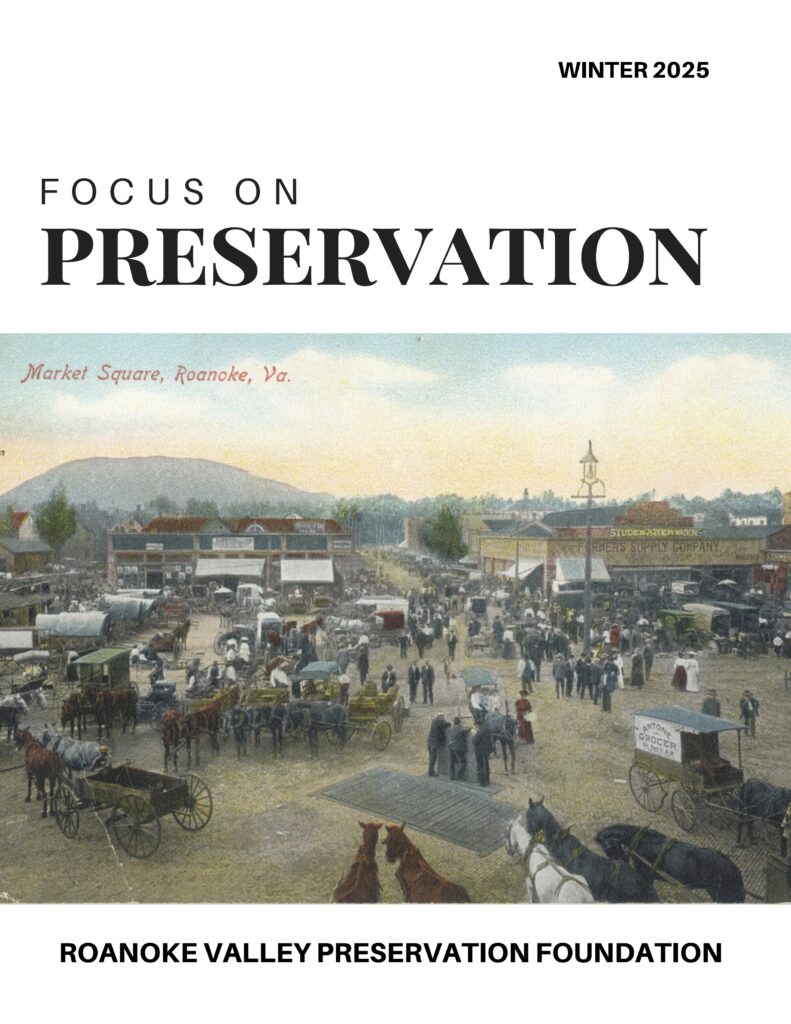
Roanoke Valley Preservation Foundation Summer 2025 ‘Focus on Preservation’ Newsletter

The Roanoke Valley Preservation Foundation, Inc. regularly publishes a bi-annual newsletter that shares historic, cultural, and natural preservation-related information and activities taking place throughout the Roanoke Valley, the surrounding counties and their municipalities.

We hope you will enjoy our most recent issue:  

2025 Summer Focus on Preservation Newsletter

Visit our website’s Newsletter page for a comlisting of past newsletters.

Roanoke Valley Preservation Foundation Announces 2025 Endangered Sites

As the month of May is designated as Preservation Month each year, several organizations such as the National Trust for Historic Preservation, Preservation Virginia, and the Roanoke Valley Preservation Foundation announce their annual Endangered Sites list to call attention to our historical places and the possibility that these significant sites are in danger of being lost forever unless efforts are made to preserve them.

(Recent demolition of early 1900’s residential buildings on Richlieu Ave SW in Roanoke, VA)

2025 RVPF Endangered sites

The Roanoke Valley Preservation Foundation’s annual Endangered Sites list is not to shame or punish the current owners but to bring attention to these sites and encourage their preservation and stewardship. The goal is to work closely with property owners and local governments in exploring options to promote their preservation. 

Only by ongoing public awareness, partnerships and collaborations, innovative technologies, sustainable conservation practices, education and capacity-building programs, and government can we ensure the continued protection and conservation of these valuable cultural assets.  

Previous RVPF Endangered Sites listings

Visit our Endangered Sites page for additional information including lists from previous years. 

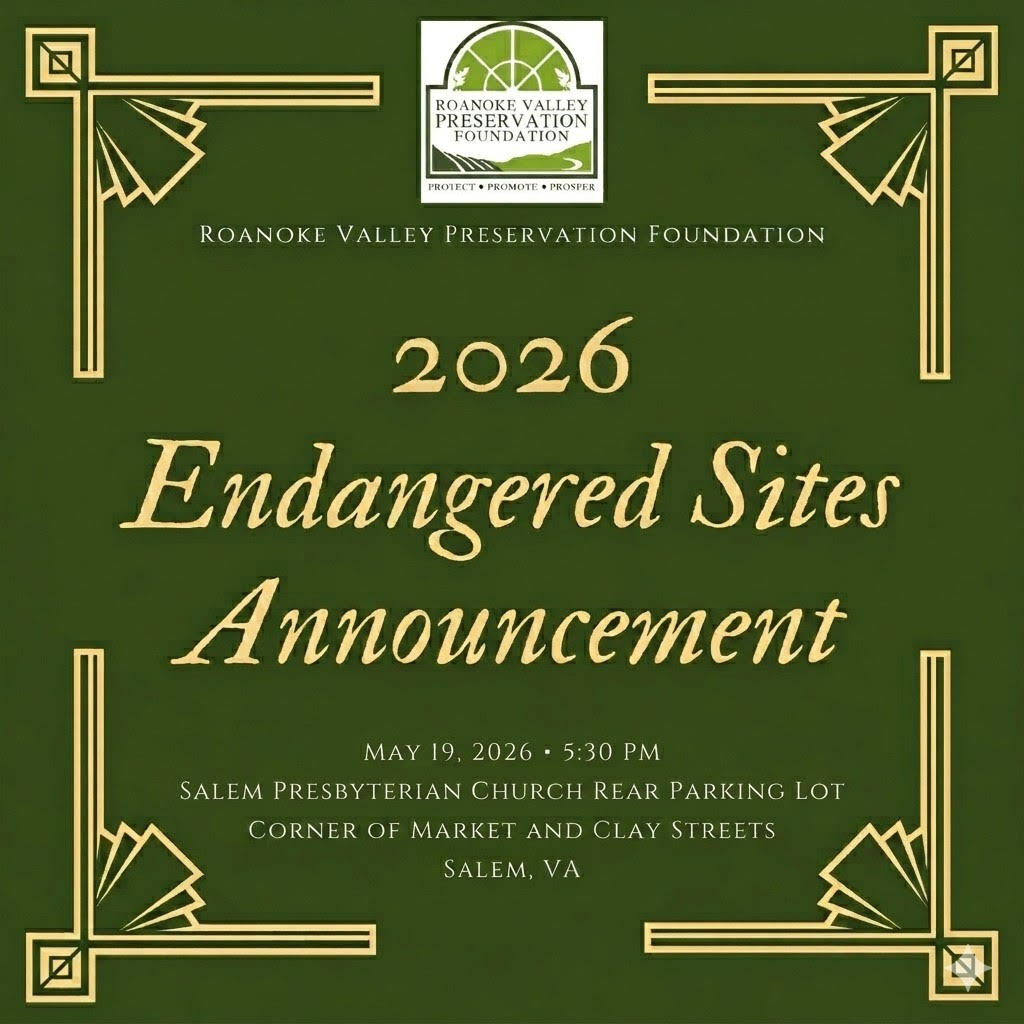
2026 RVPF Endangered sites

If you know of a significant historical, natural, and/or cultural sites in the Roanoke Valley that may be in eminent danger of being lost due to deferred maintenance, demolition, or incompatible development, please submit a 2026 Endangered Site Nomination Form by April 13, 2026 for consideration in next year’s Endangered Site listing.